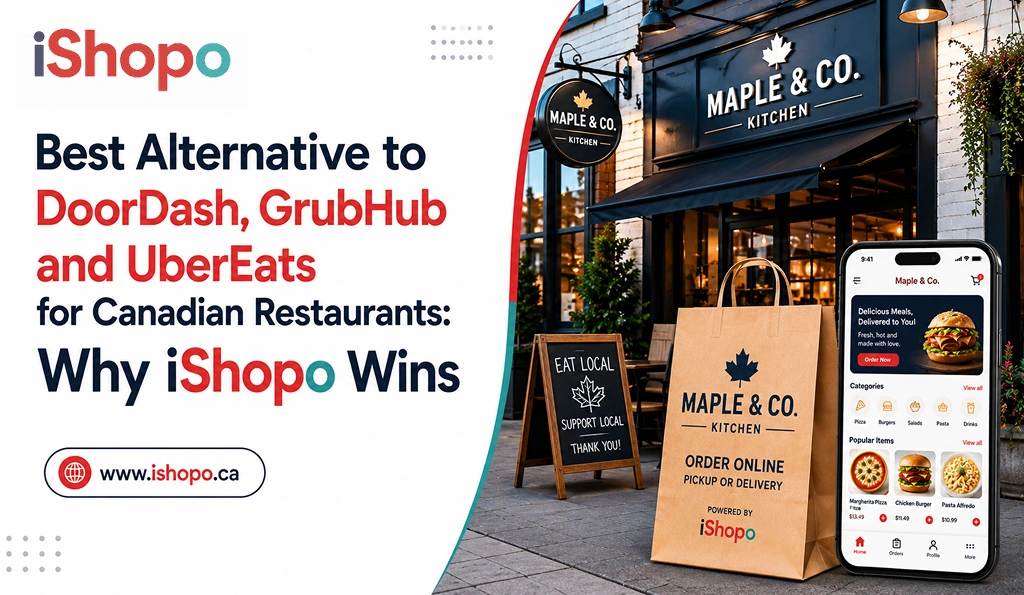

The best alternative to DoorDash, Grubhub, and Uber Eats is a direct online ordering system that charges zero commission and lets you keep your customer data. iShopo is built for exactly this, made for Canadian restaurants, cafes, food trucks, bakeries, and small food businesses.
If you run a food business in Canada, you know the feeling. An order comes in through DoorDash, you make the food, the customer is happy, and then 20 to 30 percent of that order disappears before it hits your bank account. Multiply that across hundreds of orders a month. It adds up to real money walking out the door every single week.
Even SkipTheDishes, the platform a lot of Canadians think of as the “local” option, runs on the same commission setup as DoorDash, GrubHub and UberEats. Same problem, different logo.
This blog breaks down why so many Canadian restaurant owners are searching for a commission-free online ordering system, what that alternative should actually offer, and why iShopo keeps coming up as the answer.
TL;DR
- DoorDash, GrubHub, UberEats and SkipTheDishes all charge 15 to 30 percent commission per order, which eats into already thin restaurant margins.
- These platforms also keep your customer data, so you can’t build repeat business or run your own loyalty programs.
- iShopo offers zero commission online ordering built specifically for Canadian restaurants, cafes, food trucks, bakeries and small businesses.
- Switching to iShopo takes days, not months, and comes with a free 30-minute demo with no pressure to sign up.
- The right alternative gives you your brand back, your customer list back, and your profit margin back.
Key Points
- Third-party delivery apps were never designed to make restaurants more money. They were designed to make the platform more money.
- A commission-free model means every dollar a customer spends on your food stays with your business.
- Owning customer data lets you send promotions, build loyalty programs and bring customers back without paying a platform for the privilege.
- iShopo supports dine-in QR ordering, pickup and delivery, all from one branded system.
- Canadian restaurants need a platform that understands Canadian payment processing, tax rules and local business needs, not a US-first tool with Canada bolted on.
- Switching platforms feels scary, but with the right partner it can be done in a matter of days with no disruption to your daily operations.
Why Canadian Restaurants Are Looking for the Best Alternative to DoorDash, GrubHub & UberEats
For years, signing up with DoorDash, GrubHub or UberEats felt like the only option. These platforms had the customers, the apps, and the marketing budgets. Restaurants joined because that’s where people were ordering from.
But the math has changed. Commission rates that started around 15 percent for many restaurants have climbed toward 30 percent on some plans. For a restaurant working on a 10 to 15 percent profit margin, handing over 30 percent of every delivery order isn’t just expensive. It can mean you’re losing money on every single order you fulfill through these apps.
Add in marketing fees, delivery fees, and the cost of staff time spent managing multiple tablets and order screens, and the real cost of these platforms is higher than most owners realize until they actually sit down and calculate it.
1. What These Platforms Actually Cost You Every Month
Let’s say your restaurant does 300 delivery orders a month through DoorDash at an average order value of $35. At a 25 percent commission, that’s $2,625 gone every single month, before you even count card processing fees or marketing add-ons some platforms push restaurants to buy. This is the same math that comes up whenever a Canadian owner asks how much DoorDash charges restaurants in Canada. The honest answer is “more than most people expect once you add it all up.”
Now picture that money staying in your account instead. That’s the difference between a slow month and a month where you can actually hire someone, fix the walk-in fridge, or just breathe a little easier. Commission isn’t a small line item. For a lot of restaurants, it’s the single biggest expense after food and labour, and it’s one that grows every time sales grow.
2. The Hidden Price of Losing Your Customer Data
Here’s something that doesn’t show up on the monthly invoice but matters just as much. When someone orders through DoorDash, GrubHub or UberEats, that customer belongs to the platform, not to you.
You don’t get their email. You don’t get their phone number. You can’t send them a message next week saying “hey, we added a new pizza” or “come back this weekend for 10 percent off.” The platform owns that relationship and can use it to push that same customer to your competitor down the street with one tap.
Over time, this means you’re spending money to acquire customers you’ll never actually own. Every order brings in revenue once, but builds zero long-term value for your business.
The Real Problem With DoorDash, GrubHub & UberEats for Canadian Food Businesses
Beyond the fees and the missing customer data, there’s a bigger issue. These platforms slowly turn your restaurant into a faceless listing inside someone else’s app.
Think about how a customer finds your food on DoorDash. They open the app, search for “pizza near me,” and see a grid of restaurant logos that all look roughly the same size, with the same fonts, the same layout. Your restaurant’s personality, the thing that actually makes people choose you, gets flattened into a thumbnail and a star rating.
For Canadian restaurants especially, where so much of the food business is built on local reputation, word of mouth, and community ties, this kind of facelessness works against you. People in your neighbourhood know your name. The app doesn’t care about that.
1. Your Brand Becomes Invisible on Third-Party Apps
When a customer places an order at your restaurant via UberEats, the receipt, the app screen, the delivery notification – all of it states UberEats. Even if your logo can very easily be distinguished, the experience belongs to Uber.
It is much more important than it sounds. Branding is a remarkable way in which one builds trust and recognition over time.
Every time a customer enjoys your food through the branding of another, you are gifting that brand-building opportunity to a well-established company that doesn’t require it, whereas you do. Conversely, a branded ordering experience displays your name, your colours as well as your story to the customer from the first click to the last “thank you for your order” screen.
2. Why Restaurants Lose Repeat Customers to These Platforms
Repeat customers are the backbone of any food business. They cost less to serve because you’re not spending on ads to win them over again and again.
But on a marketplace app, repeat business gets harder to earn. The customer who ordered from you last week might see five other restaurants advertised at the top of their screen this week, sometimes restaurants that are paying for that placement. Your loyal customer becomes a target for your competitors, on a platform you’re paying to be part of.
Without direct access to your customers, you can’t remind them you exist, can’t thank them for coming back, and can’t build the kind of relationship that turns a one-time order into a weekly habit.
What the Best Alternative to DoorDash, GrubHub & UberEats Should Actually Offer
So what does a real alternative look like? Not just a smaller version of the same model, but something built around what actually helps a restaurant grow.
A genuine alternative needs to give you back three things: your money, your customers, and your brand. People searching for which food ordering tools let restaurants keep customer data are usually asking this exact question without realizing it. Anything less than all three is just a different flavour of the same problem.
1. Zero Commission vs Commission-Based Pricing
This is the most direct difference. Commission-based platforms take a cut of every order, forever. The more successful you become, the more they make, and the more you pay.
A zero-commission model flips that. You might pay a flat monthly fee, but every order you bring in keeps its full value. As your restaurant grows and takes more orders, your cost stays the same while commission-based fees would keep climbing right alongside your sales.
2. Owning Your Customer Data and Relationships
The right alternative gives you a list. Names, emails, phone numbers, order history. This is the asset that lets you run a Friday night promotion, send a birthday discount, or simply tell regulars about a new menu item.
Without this list, your marketing options are basically limited to whatever the third-party app decides to show your customers, and usually that means paying extra for visibility.
3. Branded Online Ordering vs Marketplace Listing
A branded ordering page or app puts your restaurant front and center. Customers land on something that looks and feels like you, not a marketplace where you’re competing for attention on the same page as five other restaurants.
This builds trust. Customers feel like they’re ordering directly from a business they know, which makes them more likely to come back and more likely to recommend you to friends.
Why iShopo Is the Best Alternative to DoorDash, GrubHub and UberEats in Canada
iShopo is an online ordering platform built for Canadian restaurants and food businesses that want to stop handing over a chunk of every order to third-party apps.
The core idea is simple. Give restaurant owners a branded ordering system that costs zero commission, works for dine-in, pickup and delivery, and is set up specifically with Canadian operations in mind.
1. Zero Commission, Keep 100% of Every Order
With iShopo’s zero commission ordering setup, there’s no per-order cut taken out of your revenue. Whatever the customer pays for their food is what stays in your business, aside from standard payment processing, which every platform has.
For a restaurant doing even a modest volume of online orders each month, this difference adds up fast. Money that used to go to commission can go toward better ingredients, more staff hours, or simply staying afloat during a slow season.
2. Built for Canadian Restaurants, Cafes, Bakeries, Food Trucks and QSRs
A lot of online ordering platforms are built first for the US market and then adjusted for Canada as an afterthought. iShopo takes the opposite approach. It’s built with Canadian dollars, Canadian payment processors, and the day-to-day reality of running a food business in Canadian cities and towns in mind from the start.
Whether you’re running a pizza shop in Mississauga, a bakery in Halifax, a food truck in Calgary, or a quick service restaurant chain across multiple provinces, the platform is designed to fit how Canadian food businesses actually operate, including handling things like Canadian tax setups without extra workarounds.
3. Get Started With a Free 30-Minute Demo, No Pressure
If you’re reading this and thinking it sounds good but you’re not sure it’s right for your business, that’s a fair reaction. The way to find out is a short demo.
iShopo offers a free 30-minute walkthrough where you can see exactly how the platform works for a business like yours, ask questions specific to your setup, and decide for yourself, with zero obligation to sign up afterward. No pushy sales calls, just a straightforward look at whether it fits.
DoorDash vs GrubHub vs UberEats vs iShopo: Side-by-Side Comparison
Here’s how the major platforms stack up against iShopo on the things that matter most to restaurant owners.
| Factor | DoorDash | GrubHub | UberEats | iShopo |
| Commission per order | 15% to 30% | 15% to 30% | 15% to 30% | 0% |
| Customer data ownership | Platform owns it | Platform owns it | Platform owns it | Restaurant owns it |
| Branded ordering experience | No, marketplace listing | Limited, Grubhub Direct adds branding | No, marketplace listing | Yes, fully branded |
| Dine-in QR ordering | Not standard | Not standard | Not standard | Yes |
| Built for Canadian operations | US-first, Canada available | US-first, Canada available | US-first, Canada available | Canada-focused |
| Setup time | Quick signup, limited customization | Quick signup, limited customization | Quick signup, limited customization | Days, with guided onboarding |
| Pricing model | Per-order commission | Per-order commission | Per-order commission | Flat pricing, no commission |
How iShopo Compares as the Best Alternative to DoorDash, GrubHub & UberEats for Different Business Types
Not every food business runs the same way, and the right platform should flex to fit different setups rather than forcing everyone into one model.
1. Pizza Shops and QSRs
Pizza shops and quick service restaurants tend to run high order volumes with tight margins on each item. This is exactly where commission fees hurt the most. A $1 to $2 cut on a $15 order is a much bigger percentage hit than it looks.
With iShopo’s online pizza ordering system, a pizza shop can take orders for pickup and delivery without losing a slice of every transaction. Combined with QR code ordering for dine-in customers, the same system handles counter traffic and online demand without needing separate tools. The same setup works well for QSRs and fast food spots running on tight turnaround times.
2. Cafes and Bakeries
Cafes and bakeries often deal with smaller average order sizes, which makes percentage-based commissions feel even more painful. Losing 20 percent of a $6 coffee order adds up fast across a busy morning rush.
iShopo’s cafe online ordering system and bakery ordering system let owners set up pre-orders for pickup, manage daily specials, and keep customers coming back with direct promotions, all without a platform taking a cut of every croissant sold.
3. Food Trucks
Food trucks deal with a unique challenge. Location changes, hours can be irregular, and customers need a way to know where the truck is and what’s on the menu that day.
A branded setup through iShopo’s food truck ordering system gives owners a consistent place for customers to order ahead, see updated locations and menus, and skip the line, all under their own name rather than buried in a delivery app alongside dozens of other trucks.
4. Retail and Small Food Businesses
Small retail food businesses, think specialty grocers, meal prep companies, or snack producers, often get overlooked by delivery apps built mainly for sit-down restaurants.
iShopo’s online ordering system for retail stores and small business ordering system work for these kinds of businesses too, giving them an online storefront without forcing them into a restaurant-shaped box that doesn’t quite fit.
How to Switch to iShopo as Your DoorDash, GrubHub & UberEats Alternative
Switching platforms can feel like a big project, but it doesn’t have to disrupt your daily operations if it’s done right.
1. Step-by-Step Setup Process
The first step is the free 30-minute demo, where the iShopo team walks through your menu, your current setup, and what you need. From there, your menu gets built into the platform, branding gets applied so the ordering page looks like yours, and payment processing gets connected. You can check pricing ahead of time if you want to know what to expect.
Once everything is tested and working, you can start taking orders through iShopo while still running your existing operations, so there’s no period where you’re without an ordering system. Many restaurants run both for a short overlap period while customers get used to the new ordering link.
2. How Long Does Switching Actually Take
For most restaurants, the core setup can be done within a few days of the initial demo. Menu complexity is the biggest factor. A simple menu with a handful of categories moves faster than a large menu with dozens of items, modifiers and combos.
Either way, it’s measured in days, not the weeks or months some owners expect when they hear the word “migration.”
Common Mistakes Restaurants Make When Choosing a DoorDash, GrubHub or UberEats Alternative
1. Picking Based on Price Alone
The cheapest monthly fee isn’t always the best deal if the platform is clunky, hard for customers to use, or missing features your business actually needs. A slightly higher fee that actually gets used and brings in orders is worth more than a bargain platform that sits unused.
2. Ignoring Canadian-Specific Needs
Some platforms are built for the US market first, with Canadian support added later as a checkbox feature. This can mean awkward payment processing, confusing tax handling, or support hours that don’t match Canadian time zones.
3. Not Testing Before Committing
Signing a long contract without seeing how the platform actually works in practice is a common mistake. A short demo can show you in 30 minutes whether something fits your workflow or feels like extra work.
4. Underestimating the Value of Owning Customer Data
Some owners focus only on the commission savings and miss the bigger picture: owning your customer list is what lets you grow without constantly paying for new customer acquisition through ads or platform fees.
5. Trying to Do Everything at Once
Trying to switch every part of your operations overnight, menu, branding, delivery, loyalty, all in one go, can create unnecessary stress. A platform that lets you roll out features gradually, starting with the basics, tends to lead to a smoother transition.
6. The Bottom Line
DoorDash, GrubHub, UberEats and SkipTheDishes got a lot of Canadian restaurants through tough times by bringing in orders when nothing else was working. But the commission model that made sense as a stopgap doesn’t make sense as a permanent business strategy.
iShopo gives Canadian restaurants, cafes, bakeries, food trucks and small food businesses a commission-free online ordering system built to take orders directly, keep customer relationships, and stop handing over a fixed percentage of hard-earned revenue every month. Whatever type of food business you run, there’s likely a setup that fits your restaurant type.
If commission fees have been quietly draining your profits, a free 30-minute demo with iShopo is a low-pressure way to see what a better setup actually looks like.
FAQs
Q. What is the best alternative to DoorDash, GrubHub and UberEats for restaurants?
The best alternative is a zero-commission, branded online ordering platform like iShopo. It lets restaurants take direct orders for pickup, delivery and dine-in without losing 15 to 30 percent of every order to commission fees.
Q. Will switching away from DoorDash, GrubHub or UberEats mean losing customers?
But this can change if you decide to go with a platform that not only helps your branding stay consistent but also makes ordering a breeze. Lots of customers actually like ordering from the restaurant’s own page once they find it, and you also get the chance to nudge them towards buying again with direct promotions.
Q. How long does it take to switch to iShopo from DoorDash or UberEats?
Most restaurants can get set up within a few days of their first demo. The exact time depends on how large and complex your menu is, but there’s no need to stop using your current platform while the new system gets set up.
Q. Is iShopo really commission-free for Canadian restaurants?
Yes. iShopo doesn’t take a percentage of your order revenue. Restaurants pay a flat fee instead, so as your sales grow, your costs don’t grow along with them the way commission-based fees do.
Q. Can I still offer delivery if I move to a commission-free platform like iShopo?
Yes. You can manage pickup, delivery and dine-in orders through one branded system, so customers get the same convenience they’re used to without the commission cut going to a third party.
Q. How much does DoorDash charge restaurants in Canada?
A.DoorDash usually charges food outlets in Canada a commission of about 15 to 30 percent per order based on the plan they choose. If your monthly sales are $10 000 that means DoorDash will get $1,500 to $3,000 even before you pay for food or staff.
Q. Do restaurants pay UberEats the same way they pay DoorDash?
UberEats does have a commission-based model and generally takes a share of the order, usually in a range of 15 – 30%. Like DoorDash, GrubHub or SkipTheDishes, restaurants on UberEats are suffering from the margin squeeze and that is the main reason many of them are considering zero commission ordering alternatives.
Q. Is custom app development a better option than using a platform like iShopo?
Typically, custom software development projects involve expenses amounting to several tens of thousands of dollars and the duration of such projects usually extends over several months. But, with iShopo, you can have your own branded ordering system at no upfront cost and without any waiting time. Because of this, iShopo turns out to be a more viable solution for most independent restaurants and small food-related businesses.